A Non-Fan Review: Doom (2016)

The original Doom, released at the end of 1993, is the first-person shooter. At this point it is a classic staple of the medium and there’s not much I can say about it that others have said better. What I can tell you about is my ambivalence towards it, why that is, and my opinion of its reboot/remake/whatever.

My Highway to Hell

I wasn’t even in my preteens at the time but ultraviolent material wasn’t unfamiliar for me (I loved watching Aliens as a young’un — even got the action figures!) and I did play videogames. Problem is that, overall, I’m not that fond of first-person shooters. Most are amusing but in a fleeting way and few of them — for example, the first installment of the F.E.A.R. series — ever become truly memorable enough to warrant a revisit. It could be argued the devil is in the details, but how many times can you really make shooting a gun from that limited perspective work without getting tiring in some way? At least Portal has puzzle-platforming elements and, though I have yet to play any of it (perhaps in the future!), the Thief series’ emphasis on stealth over combat is far more enticing to me as gameplay.

That is not to say I hated Doom ‘93 — only that I did not share the same enthusiasm as others. I absolutely get why so many like it and would not fault them for it, being a child of the 90’s myself. It was a singular vision by a tight-knit group of friends with highly focused shooting mechanics as well as level design that allowed a wide berth of modification. A cultural product that almost perfectly represented the 90’s attitude of the United States; still reveling in 80’s-style excess and gaudy aesthetics while scoffing at the moralistic hysteria of that decade, often in the form of metal bands ironically embracing Satanism and determined to offend fragile religious sensibilities with lots of demonic imagery and cartoonish viscera, but others tried pushing the envelope whether stand-up comedians or filmmakers in their own way. Along with influence from Dungeons & Dragons as well as Aliens (there it is again!), John Carmack and company at id Software managed to do that with gaming and its legacy remains. Other popular titles at the time either failed to remain relevant, especially Duke Nukem (evidenced by Forever’s abysmal reception from just about everyone), or simply faded from memory save for a niche…

Death By Swirly

Perhaps I was too young, but there wasn’t any forbidden fruit appeal for me either. Quake, on the other hand, was more enjoyable as a personal experience. That, however, was due to Nine Inch Nails’ Trent Reznor composing darkly atmospheric music for the game more than anything else. I even preferred the original Duke Nukem and I’m honestly embarrassed for having liked that for all the wrong reasons (i.e. sexual titillation). Ultimately, my reasons for liking them had less to do with them as games than having a prominent element that resonated enough with me whether it was musical bliss or perverse indulgence.

All that said: how was the Doom of 2016 (which I shall dub New Doom from here on) as far as the single-player campaign went? It was certainly never as boring as many supposedly realistic, military-themed titles of the same genre have been recently. At least, initially…

Better to Reign Than to Serve

Having fast-paced arena combat over the cover-based kind with old school-style health pick-ups and ammo drops is refreshing, greatly helped by the variety of enemy A.I. and their phenomenal art direction. They aren’t just 3D renditions of their original 2D sprites but revamped with modern tech while still maintaining the feel of being in an interactive death metal concept album of yesteryear. While it would be odd to describe them as “beautiful” — given the malformed and grotesque visages — but are so deeply detailed and textured that it’s hard to think of a better word. The developers could’ve easily fallen into the trap of over-designing them, much in the same way so many latter-day Final Fantasy characters are perplexingly garbed with innumerable belts or Michael Jacksonesque zippers that only makes them harder to tell apart. Every mutated human and unholy abomination is distinct enough that assure these frantic battles never becoming visually confusing. A quick glance is enough to tell you who is who and how to blow them to smithereens.

NOM NOM NOM NOM NOM

Even the flimsy plotline has this strange charm, as if it were a somewhat revised schlocky 1950’s B-movie script that managed to attain the high production values of a Hollywood blockbuster. New Doom’s ridiculous story is done in an ostensibly straight-faced manner, but there is a darkly humorous undercurrent when juxtaposed with such over-the-top imagery to the point of being cartoony. It’s hilarious that data files you pick up on Mancubi and the Cyberdemon are dryly-written, stern scientific reports or that the audio logs describing the Doom Slayer’s legendary status among demonkind may as well be from a Todd McFarlane or Rob Liefeld comicbook. It doesn’t break the forth wall constantly, winking and nudging the audience to oblivion, to remind you of how funny it supposedly is even though it only grates. The closest thing to outright self-awareness is how the Doom Slayer’s behavior resembles the mindset of the game’s targeted audience; his only desire to obliterate every monster he crosses, to put an end to this Hellish plague in whatever way possible, and he hates being interrupted from it.

Unfortunately there is the needlessly layered upgrade system so many action games seem to have (perhaps due to some bizarre contractual obligations) but they manage to ease the frustration with some simple solutions. The level design does not waste anyone’s time with each area’s layout magnificently structured — horizontally and vertically — using physical space efficiently for both combat and exploration. You don’t have to search a seemingly endless series of copy-pasted corridors and identical footlockers for items like the haphazardly constructed Shadow Warrior reboot of 2013, thanks to the chainsaw turning enemies into bullet fountains and “glory kills” allowing for regeneration. It helps that one of the special abilities gained indicates all collectibles on the map that — outside of increasing health, armor, and ammo capacity — makes it one of the more useful upgrades available. Not to say those upgrades don’t add variety but, akin to Doom ‘93, each gun (save for the incredibly vestigial pistol) functions normally well enough without any alternate firing modes attached. Such additions come as trying to fix what isn’t broke. Worse, it ends up making the game too easy.

But my favorite feature is the musical soundtrack eerily reflecting the action taking place on-screen. It is clever sound engineering that adds a lot more to the experience than you’d expect but makes perfect sense, as I’ve previously described the game as an interactive death metal concept album of yesteryear. The gunfire and explosions fugue seamlessly with guitar riffs and percussion that make the music more than just being atmospheric — it is the atmosphere. Of all the elements of this reboot, though as modernized as everything else, the soundtrack is the most spiritually faithful to Doom ‘93. They’re a far cry from the midi proxies of Metallica and Slayer songs but it’s not hard to imagine (given Quake) id Software doing similar if they had the resources back then.

Damned to Disappoint…

This is your brain on guns. Big fucking guns.

Now, with all these compliments, one would assume my overall experience was a positive one and changed my sentiment on the series as a whole — but you’d be wrong. As time went on and I reached the end of the single-player campaign, I found myself becoming slowly soured on the whole thing and wondering when it’d finally be over. Reaching the campaign’s conclusion, with its meaningless sequel-hook, did not carry the same sense of elation and fulfillment that came with (say) Metal Gear Solid 3 and its dénouement. Even attempting to replay a level to attain missed collectables was downright painful.

Maybe it’s because, like the majority of first-person shooters, the endless cacophony of bullets being fired and explosions going off become a repetitive chore as the body-count rises with playtime. No matter how refined the mechanics and graphics, or managing to keep the action fast-paced with little dead air inbetween, it needs an element like the aforementioned Portal’s platform-based wormhole puzzles or F.E.A.R.’s intimidating A.I. hostiles. However the Doom Slayer, unlike Chell, is more cumbersome than agile and demonkind far less terrifying than a legion of psychic clones in SWAT gear.

GET THAT LIGHTSABER AWAY FROM ME, OPTIMUS PRIME!!!

Its God of War-style QTEs are repeated so often that, especially for larger enemies, it feels a bit too effortless and that there’s no serious threat. It lacks tension once one is well-acquainted with the control scheme, supplemented by all the upgrades given, and the whole thing ends up becoming even easier than it already was before. Maybe this is “fun” by those who are who don’t mind endlessly blasting through hell-beasts non-stop but I just find it unengaging without something more. Action without further context or contrast is dull, because spectacle can only go so far before the excitement dissipates and loses all meaning. Without that something — whatever it is — it’s just bells and whistles. It’s a distracting noise that, with enough time, you’ll completely forget after a while.

I suppose it doesn’t help, partly from fatigue and desperation, there’s been a lot of hyperbolic praise attached to the title due to the overexposure and the diminishing returns of series like Call of Duty and Battlefield. It’s understandable to feel such exhaustion given I had it as well — I was already sick to death of all things World War 2, videogames included, before that. The problem, however, comes from people treating the game less like a throwback with a new coat of paint — which is perfectly fine by itself — than it is some kind of innovative entry that redefines the genre when it isn’t that whatsoever. It’s bad enough when the game is at the top of various “best of 2016” lists, which only proves how disappointing 2016 was for videogames, but worse when certain internet personalities make an absurd claim as it being “revolutionary” because of things such as…the variety of QTE animations. Like, really? Have we come to the point where that is considered “revolutionary”? Are our standards so low now that a regression in form is erroneously viewed as progression for such a superficial element? Perhaps I’d be less annoyed if that person, despite rightfully admonishing the company’s odious policy of denying early review copies, didn’t sound as if Bethesda Softworks paid him to give such accolades and promised to be quoted on the the “Game of the Year” edition box art.

To clarify, lest I be misunderstood: New Doom is not a badly-made game whatsoever. On a purely technical level, it is indeed marvelous and one should give credit where it is due. The polish that went into this game’s graphics, controls, and level design are sublime and that’s not surprising with id Software’s history — that is why I started off as complimentary. But, at the same time, functionality and optimal craft alone should not be the criteria as to what makes a gaming experience worth of one’s time and attention overall. If videogames are going to be considered a legitimate form of Art, as I would like them to, then the quality of a game needs to be more than the sum of its most mechanistic parts.

Gotta collect ’em all! $99.99 each!!!

When people defend an otherwise terrible film like, for example, James Cameron’s Avatar by claiming the special effects are impressive — it’s utterly meaningless and beside the point. The elaborate computer-generated imagery does not make up for the complete lack of originality, poor characterization and dialogue, or Cameron’s disingenuously heavy-handed environmentalism (the “noble savage” bullshit wasn’t much better). Perhaps none of that will register upon a first viewing — but it sure will when watching it again or at least thinking about it enough afterwards. That’s not to say New Doom has the same problems as that film (thankfully), just that it’s incredibly overrated and (like my fondness of the original Duke Nukem) for all the wrong reasons.

[Originally posted on 8/7/17 @ Medium.com]
Apple v. Orange Review: Bastion and Transistor (w/spoilers)

Apples and oranges aren’t that different, really. I mean, they’re both fruit[…]I could understand if you said ‘that’s like comparing apples and uranium ‘ or ‘that’s like comparing apples with baby wolverines ‘ or ‘that’s like comparing apples with the early work of Raymond Carver ‘ or ‘that’s like comparing apples with hermaphroditic ground sloths.’ Those would all be valid examples of profound disparity.”

– Chuck Klosterman (Sex, Drugs, and Cocoa Puffs)

So, what’s the big deal?

Supergiant Games’ new release, Pyre, is coming out later this month and I thought a compare-and-contrast retrospective on their previous titles would be relevant.

Unlike many other mainstream titles, both Bastion and Transistor rely more on implication than exposition; having its audience fill in the spaces left purposefully blank. It’s a style of storytelling I find preferable for videogames, rather than another wrong-headed attempt to be “cinematic.” Because, as we all know, the best way to improve interactive entertainment is to slavishly mimic a passive medium (not really though). There is more to intrigue and incentive for players to actually ponder and further explore the physical setting, which reinforces a seldom felt sense of immersion. A rarity at a time when extravagant facades, built upon shoddy foundations, are the norm. Especially as it can occur through gameplay rather than as an overlong movie cut to pieces and interjected, no matter how awkward or contrary, in between the parts that begrudgingly give the audience agency.

That isn’t to say either Bastion or Transistor is entirely successful. Even with the limitations that come from being a newer studio, Supergiant Games does an admirable effort with the resources at hand. However, the flaws are noticeable enough to distract.

Then what’re the…er, plots at hand?

Chris Franklin’s interpretation of Bastion being, metaphorically, about recovering from a disastrous break-up of a long-term relationship is hard to argue against and I can appreciate that. The problem, however, is that Bastion establishes a very lived-in ecosystem with basic laws attached that contradict its interpretive elements. Given that, how does the actual plot function? To answer that question in one fell swoop: it starts and remains strong up until the game’s midpoint, leading to a revelation of morally reprehensible actions by Caeldonia towards the Ura — that the titular device was, in fact, a weapon for ethnic cleansing — with an endgame twist made inane by lacking any precedence.

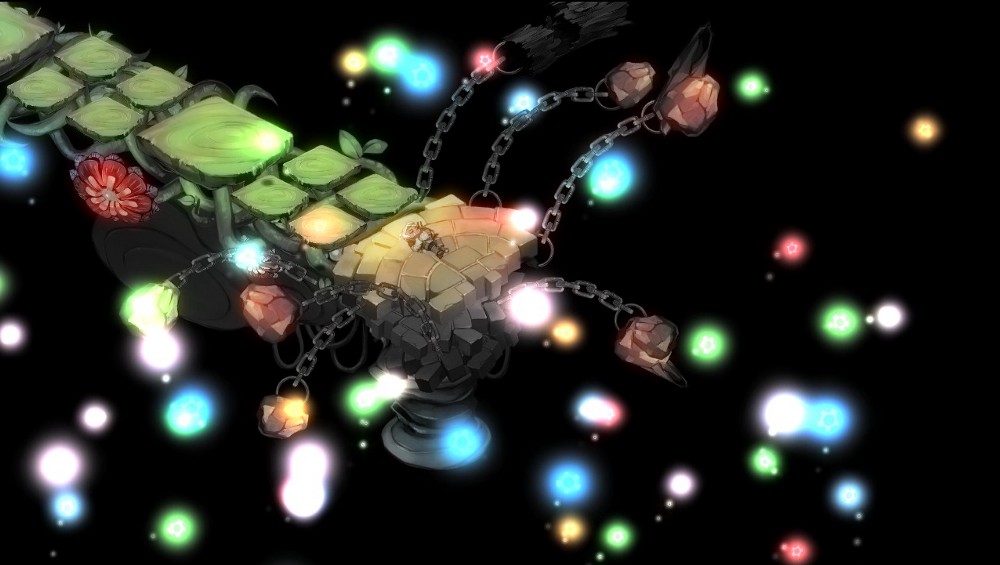
Along with being a doomsday weapon, it’s apparently a TARDIS that looked like a vividly lush floating island…or something.

…Wait, what…?

Yes, in fact, Ruckus — the character acting as the game’s narrative voice — explains that the device was meant to rebuild the world as much as destroy it; but there are no clues given that it could bend time and space. This reveal is brought up during the final level, occurring at so late a point that it is downright contrivance. Internal logic be damned as the narration is implied to have come from a person aware of future events…except Ruckus claimed that, in literally winding back the clock, events would be forgotten by those who experienced them. Why is he immune to such effects? Oh, right, there wouldn’t be an omnipresent narrator otherwise. For that matter, why create a device that can act as both a terraformer and a weapon of mass destruction? Why have an Ura refugee work on the device or give him the knowledge to use it against them? The more information given, the more plot holes become apparent.

And Transistor?

In deciding to be far more abstract and less concrete, it fares better as a minimalistic and interpretive story. What little explanation is given remains obscure, as do the rules applied to the setting, making it more difficult to determine whether or not one element of the plot is inconsistent with the rest.

Much to my chagrin, the patronizing adage of “your mileage may vary” would apply on the issue of whether or not that works in its favor. Personally, I loved the story. It gave me the same sense of wonder I had when watching ReBoot as a kid and then years later with The Matrix during my early adolescence — seeing it as an allegory of the democratization of culture in the internet age, of the dangers in relying so much on consensus that it becomes erroneously conflated with quality. Yet, at the same time, one can’t assert those less enthused with this game are somehow wrong or “don’t get it.”

It’s like an expressionist painting or Dadaist assemblage: while one person can find meaning in it whatever the reason, another can find none, and both perspectives are valid. Only a person who claims to understand it more than anyone else is full of shit.

What I will argue with is how it deals with voice acting. It bothered me that, in Bastion, Zia is only given a speaking voice at the penultimate scene. If she could have a voice before, why didn’t she have it then? Transistor is even more problematic in that it not only renders the female protagonist a mute before her introduction (even Ariel in The Little Mermaid got better treatment than that) and explained away with a lazy hand-wave, but there are male characters in the supporting cast who do get their own voices. Her talking sword drones on, sounding like Harrison Ford in Blade Runner reading passages from a Raymond Chandler novel, in a one-way conversation — even though some friendly or flirtatious banter would’ve added so much more. Red is a character as indicated by the comments she posts, in response to news articles found at computer terminals, where she’ll even delete what she just wrote to rephrase her statement to be more succinct or dramatic. The problem being that such terminals are wholly supplemental and leaves that characterization unseen by those who didn’t bother to look. It comes off as a sexist creative decision even if done unintentionally — moreso given it’s been done twice now.

That is unfortunate with the game’s otherwise progressive attitude towards sexuality and gender, as several gay characters and one transgender individual are present. None of that is treated as somehow abnormal nor their sole defining trait, instead adding a layer to their overall personality. It’s the kind of story beat needed in the medium.

What’s their commonality?

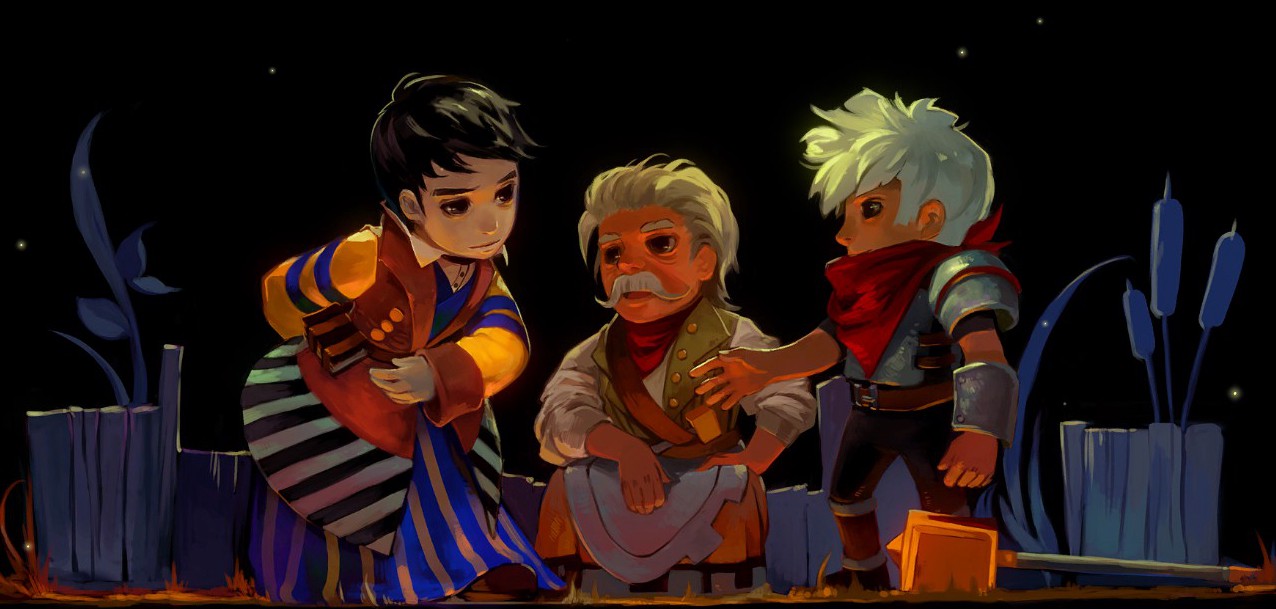
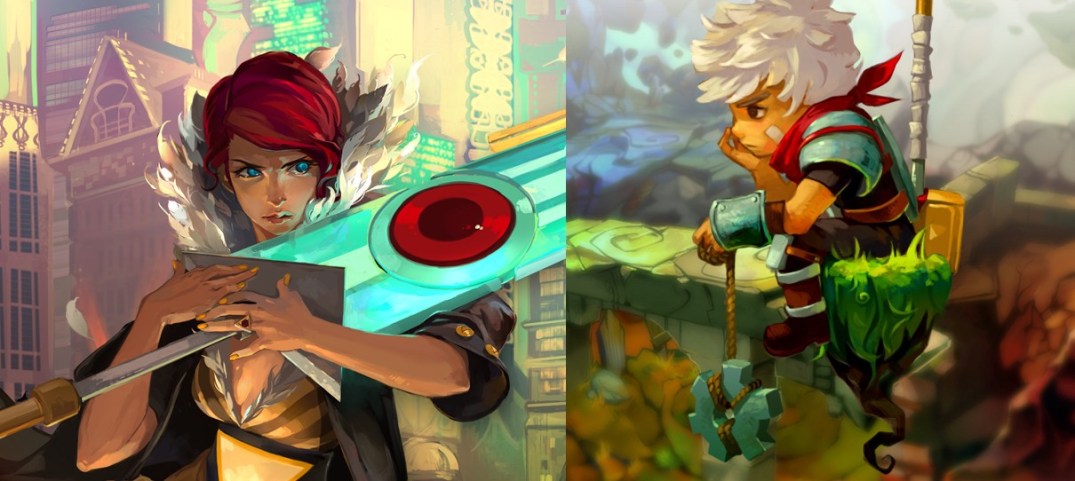
As said before, they were developed by Supergiant Games and are isometric action-adventure videogames with RPG elements. The art direction, from Jen Zee, is more evocative of painted illustrations than computer-generated imagery and is accompanied by a collaborative musical score by Darren Korb with vocals by Ashley Lynn Barrett. Logan Cunningham also provides most of the voice-over work on both titles.

And the differences?

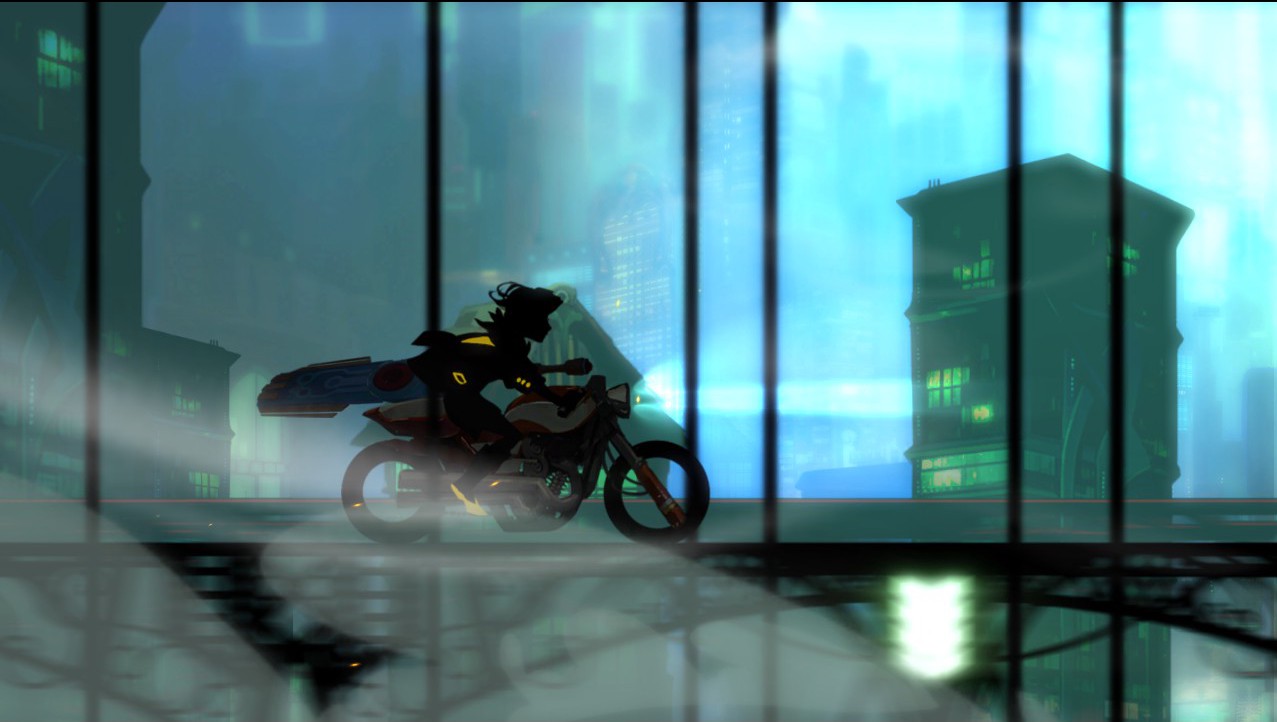
Bastion is hack n’ slash while Transistor has mixed real-time/turn-based combat mechanics that emphasize strategic usage of special abilities and numerous variations when combined with others for either an active or passive effect. The earlier is also Steampunk filtered through Spaghetti Western aesthetics, whereas the latter is cyberpunk infused with noir sensibilities and a fondness for Art Nouveau.

Okay, whatever — how about the gameplay and graphics?

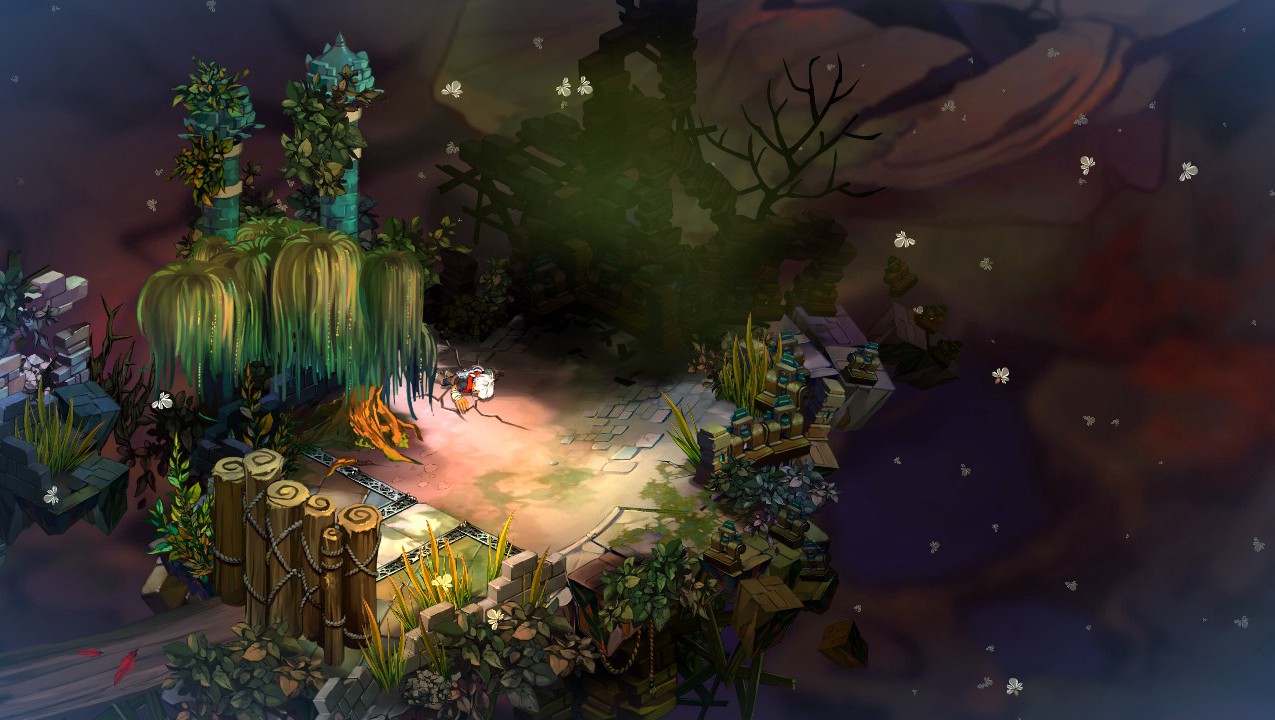
Aside from the chibi-proportioned characters of Bastion contrasting with the more realistically formed ones in Transistor, there isn’t much difference in terms of overall in-game graphical quality. It goes without saying that Jen Zee’s art direction is absolutely lovely. It’s in the level design — in how they progress — that they diverge.

Despite the isometric view, Bastion has the pretense of being a platformer as well as encouraging exploration (the operative word here being “pretense”). Blocks of flooring, both small and large, appear as the player character ventures forward, that indicate possible hidden paths. But in reality it’s actually quite linear and those paths are easily found. The items they lead to add texture to the game’s setting, but that’s about it. It also doesn’t help that these platforms are littered with both breakable items and décor, which are hard to determine from one another, adding to frustration in combat when it comes to dodge-rolling away. There’s even a level selection screen though one can’t replay completed areas nor have much choice as which to play next.

Transistor, to both its benefit and detriment, streamlines the environment and lacks the aforementioned pretenses. There’s no worry about continually falling into a void. While it does implement platform jumping as last minute as Bastion’s, it is done purely by button-prompt (rather than poorly implemented precision jumping) that functions better overall. There’s no doubt it is linear and that point A leads to point B, with very few detours for world-building texture. However, it also lacks the vibrant colors and details needed to make an environment more fit for the combat with the most gorgeous vistas — outshining even those in Bastion — being few and far inbetween.

It’s the closest I’ve come to playing an interactive Gustav Klimt painting, if only for one brief and fleeting instance. I wished the whole experience was like that…

I’d put that print on my wall!
I’d put that print on my wall!

Combat is central to both games’ mechanics and those are more dissimilar. As stated in the previous section, Bastion is a hack n’ slash and it’s a competent one — though overburdened by features disproportionate with the game’s length. Going back to the review by Chris Franklin, he praises the game for lacking anything frivolous or unnecessary in its design and I just don’t get it.

You only have two weapon slots and the game gives you a new weapon almost every level, save for the challenge areas, up to the final one. As much as variety is the spice of life and all that, it creates this problem where I’m forced to use this new weapon I’m not familiar with even though I’ve been using those I prefer or have gotten used to already. Were this to allow for various playing styles, it would be understandable, but they’re often needed in the level you find them in anyway. The game isn’t extensive enough to justify needing that many to begin with. The challenge areas themselves, save for four, only provide more money for upgrades or special skills for a specific weapon you probably won’t use otherwise. It gave me flashbacks to Assassin’s Creed 2 when they piled a bunch of melee weaponry on you, even given a steady income to buy more of them, that went unused because the wrist-blades worked well enough anyway (and, hey, they’re pretty damn cool).

Meanwhile, in Transistor, there is only the titular weapon — though it functions less as a melee instrument than it does a medium for casting spells dubbed as “Functions.” You can use a Function by itself but combining it with others can extend its range or add a status effect that stuns or weakens opponents. Alternatively, one can put it in a slot for a passive effect for the player character by, for example, spawning a decoy to distract enemies or shield them from damage. There’s a very tangible effect with each Function that can drastically change the nature of a battle. You can employ a number of viable strategies and applying them can become an engrossing experience.

When I finished Bastion, only to restart it in New Game+ mode, I felt like I saw everything the first time around and wasn’t really challenged anymore. Transistor, well after completing it, had me replaying battles that totally kicked my ass with a new set of Functions to see if they were more effective than the last.

Anything you forgot to mention? You do that sometimes. Well, a lot, actually.

Not sure why Darren Korb and Ashley Lynn Barrett haven’t made a studio album or two yet, because the soundtracks of Bastion and Transistor work wonderfully by themselves. They act as proof that original musical soundtracks for videogames can actually be better overall than all the compiled licensed music you’d find in Grand Theft Auto. Like Akira Yamaoka’s compositions for the Silent Hill series, each song perfectly represents its environment and remains tonally consistent throughout — whether it is Bastion’s idiosyncratic country/bluegrass-style strumming and percussion or Transistor’s electro-jazz beats with occasional lounge singing.

I’m guessing, based on all that, you prefer Transistor?

Well, yeah, obviously.

Yet I can only say that I liked it quite a bit but not that I loved it. There’s a lot of charming elements like its unique take on combat, the Art Nouveau aesthetics you see nowhere else, and a form of storytelling that’s (as George Wiedman once put it) borderline avant-garde. At the same time, being different doesn’t necessarily equate to quality. They’re all things I’d be pleased to see more of, to some extent or another, in the future — but their awkward implementation does not keep the rest from falling short of true greatness.

[Originally posted on 7/12/17 @ Medium.com]