Last year was far from my most productive one and…neither has this year, in fact!
I’ve got excuses, a surplus of them, but most central here – other than my recurrent writer’s block – is that I ended up becoming overwhelmingly engrossed by the subject of this piece, with the initial draft being constantly built upon and restructured over three complete playthroughs. It was honestly hard to concentrate on writing anything else and made me feel like a really lazy asshole for not being able to write things on the side (most of which remain incomplete save for just one).
That’s the most innocuous reason, though, as there was something else more personal to preoccupy me: my father passed away on March 9th, of this year, and the game ended up becoming a bit of a coping mechanism for it. Although it was already something of a coping mechanism as I was dealing with a new medical condition in the form of Type-2 diabetes that, when coupled without having any anti-depressant medication for an entire month due to medical insurance issues, lead to something of an emotional breakdown. I’m still recovering from it all but, having finally finished this review, maybe I’ll finally be able to go back to writing about anything else – for partly therapeutic reasons.
In a way, this has all been a year in the making. Hopefully, it wasn’t all in vain…
I know the pieces fit
‘Cause I watched them fall away
Mildewed and smoldering
Fundamental differing
Pure intention juxtaposed
Will set two lovers’ souls in motion
Disintegrating as it goes
Testing our communication
Some time back, I thought of making a series of reviews based on games inspired by FromSoftware’s titles like Demon’s Souls, the Dark Souls series, Bloodborne, and Sekiro – however, it never came to be, and that’s not due to lack of trying.
Imitation Isn’t Always Flattery
With very few exceptions (e.g. Blasphemous – which I’ll write about at a later date) they’re, at best, uninteresting and, at worst, unbearable to play. There’s nothing quite as painful as going into The Surge, giving it the benefit of the doubt due to its sci-fi aesthetic, and finding it harder to play as time passed; with the utterly pedestrian level design full of bland industrial environments, the identical human opponents with poor AI lacking any sense of tactics, and a story that is never intriguing enough to become invested in seeing it to the end. At least I played more of it than Mortal Shell, a game so visually ugly that it physically hurt my eyes after ten minutes, and refused to touch it since. However, even decent Soulsborne titles, such as Nioh and Salt & Sanctuary, don’t exactly work either.
Nioh certainly tries but it overcomplicates the combat to the point it’s too overwhelming, especially when coupled with the absurdly excessive weapon drops and turns inventory management into an aggravating chore. Then there’re the interchangeable levels, all of them extremely boring when compared to the likes of Sekiro, and its form of opaque storytelling without the bare minimum of characterization or proper narrative context makes it hard to feel engaged. Like The Surge and Mortal Shell, I never bothered finishing it. Salt & Sanctuary, though? I played it to the end – though even that isn’t saying much. It’s certainly more playable than the others and rather impressive it was developed by a two-person team, but it suffers from the same problem Lone Survivor had, in its admiration for Silent Hill, that it’s so derivative of its own influences. There’s very little thought put into making the setting and its lore truly distinct, an issue many Soulsborne titles have, and simply focuses on challenging gameplay. It’s bad enough the cretinous “Git Gud” types ignore some of the games’ best qualities, hyper-focusing on said challenging gameplay, but it’s worse when developers are influenced by it as well. To be fair, it does fix the problem Covenants had in the FromSoft Soulsborne titles, but…that’s it. Also, who cares? At that point, I didn’t.
Speaking of Silent Hill, Ben “Yahtzee” Crowshaw made a short video essay about how he wants the franchise to die rather than to be continued under Konami’s dubious supervision, with Blooper Team’s involvement in the Silent Hill II remake. Even though it was about Silent Hill, it could just as easily apply to every Soulsborne title not made by FromSoftware. Because what made FromSoft’s Soulsborne titles as memorable as they are was…being made by FromSoft, much like how the first four Silent Hill titles managed to work well because of Team Silent. Everyone who attempted to make their version of the material lacked a clear sense of identity and became over-reliant on brand recognition and popular trends, which will age terribly, in fiction. Even Star Wars itself is proving that, past the original trilogy, it’s simply recycling itself to the point it may as well be – as Chris Franklin eloquently described the franchise’s current state – an ouroboros. The times they do (rarely) explore new ideas or reveal unseen parts of the very lived-in setting are appreciated yet, at the same time, I’d rather it was in something else that wasn’t under the Star Wars banner.
What does any of this have to do with Elden Ring? Perhaps everything…
The light that fueled our fire
Then has burned a hole between us so
We cannot seem to reach an end
Crippling our communication
Jack of Some Trades, Master of One
There’s another reason I despise the “Git Gud” mentality and disproportionate emphasis on
challenging combat: what FromSoft’s Soulsborne titles succeeded at the most was its level design. They created these epic, surreal fantasy worlds that make it impossible to not be enticed to explore them further – the story is told visually through those environments, with as little exposition as possible. Sure, you had conversations with NPCs or read the item descriptions for further details but they were always cryptic (intentionally so, according to head developer Hidetaka Miyazaki himself). I consider it the exemplar of quality ludonarratives.
Elden Ring isn’t just the accumulation and streamlining of every motif and mechanical element FromSoft has used on their previous Soulsborne titles, but the logical extension of the level design displayed in them as being their first true open-world title. It was something I actually dreaded at first, along with the addition of crafting, because…the world of gaming is lousy with open-world titles that have become soulless (pun absolutely intended – DON’T SHAME ME!), generic hamster wheels in the form of entertainment. Why are they an open world? Just ‘cause…like Just Cause. Freedom to go about and do anything isn’t all that appealing when the sandbox is made up of endlessly copy-pasted landscapes and settlements populated by animatronic mannequins from the Uncanny Valley. Elden Ring, somehow, avoids this to an amazing degree and implies, once again, that FromSoft put a lot of love and effort into the open world they created in ways that most Western game studios regularly fail at achieving.
The size of The Lands Between, the game’s setting, is daunting and, yes, there are plenty of large fields of grass and shrubbery but there is always something around the next corner. While Assassin’s Creed will make you go to a checkpoint only to clutter the map with every side activity, store, and item pick-up – Elden Ring respects your intelligence (and curiosity) enough to just let you roam and discover things on your own. It brings back memories of playing Skyrim in its earlier hours before having to deal with numerous non-player characters who share the same seven or so voice actors between them all. Well, that and the endlessly copy-pasted dungeons and sidequests. Even in my second and third playthroughs, I was finding new things that I overlooked the first time around and in a way FromSoft’s other titles haven’t been able to do – it’s not just finding a hidden path, but having a different experience altogether.
I know the pieces fit
‘Cause I watched them tumble down
No fault, none to blame
It doesn’t mean I don’t desire to
Point the finger, blame the other
Watch the temple topple over
To bring the pieces back together
Rediscover communication
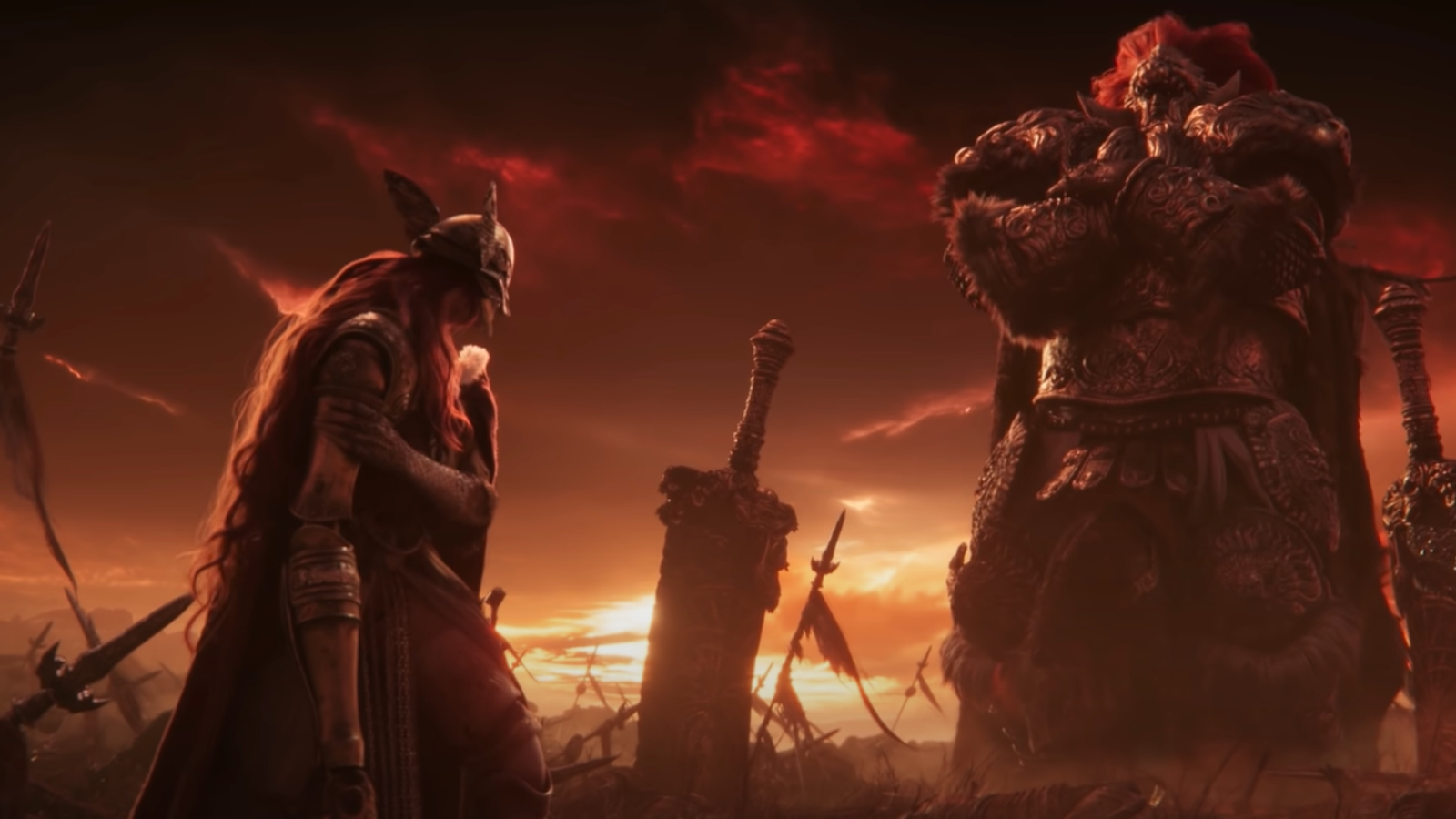
A big reason why Bloodborne and Sekiro are my two favorite Soulsborne titles by FromSoft is, in fact, their settings. The latter is a historical fantasy taking place after the Sengoku period in feudal Japan, steeped in Shinto folklore and Buddhist philosophy, while the former expertly blends Gothic and Lovecraftian horror with a Victorian steampunk atmosphere. They’re both worlds I want to go back to frequently, whereas I can now only tolerate places like Lordran, Drangleic, or Lothric due to everything they act as a vehicle for. So, it’s a good thing The Lands In Between is as interesting as it is vast, especially when one is expected to play this game for 100+ hours.
Both the major and minor regions are varied enough in their topography and atmosphere to differentiate themselves from one another. Even if the Consecrated Snowfield and Mountaintops of the Giants are similarly ice-covered landscapes, the former feels like trying to navigate through a blinding white snowstorm of vast tundra while the other evokes an equitable sense of acrophobia (i.e. fear of heights) and agoraphobia (i.e. fear of open spaces) – the latter’s vastness is appropriate, acting as a prelude to the game’s penultimate section. That penultimate section of the game, Crumbling Farum Azula, might easily be one of my favorite areas within a FromSoft Soulsborne title if only for the audacity in visual presentation. It is a place that is, somehow, both seemingly stuck in time while surrounded by dozens of impossible tornadoes, where its inhabitants echo their surroundings; they’re still alive while breaking apart, with the towers of swirling wind surrounding them slowly stripping away their flesh.
Other regions have their own charm in one way or another. Limgrave, though a typical fantasy adventure landscape, nonetheless makes for a great introductory area while providing some beautiful vistas engulfed by storms and torrential rain. The Atlus Plateau, in comparison, feels like an idyllic version of Limgrave but – as you explore – it becomes apparent everything within the place is hiding something. The region’s enclosed valley is swarming with tentacle-faced giants whose spewed bile can bring death, in the form of sudden arboreal impalement, and there’s a scenic village of windmills north of that valley wherein morbid festivities evocative of Midsommar take place. The battle-scarred yet majestic capital city of Lyndell itself lies atop a labyrinth of cursed individuals, with deformed bodies covered in numerous abnormal horn growths, as well as the massive grave of a single tribe whose extreme punishment seems based on a poorly-defined transgression. I could honestly go on for ages about Caelid, which somehow applies body horror to the geography of all things, while I can’t say much about Mt. Gelmir except the Volcano Manor is an interesting enough area that makes it worthwhile. But I’ve gone on long enough and moved onto specific locations of note like checkpoints and dungeons…
The nearly identical architecture of the churches, catacombs, and venerated tombs didn’t bother me much – it lends a sense of environmental cohesion and gives you a sense of just how ubiquitous the Golden Order was as a system. Plus, some of the latter two did offer some amusing navigational puzzles. That said, I’m less enthused by how many boss fights in this game are either recycled or regular enemies glorified with their health bar taking up the bottom of the screen than floating above their heads. This has happened in the Dark Souls series but, as no installment was as large in scope nor as long, they were never as frequent and all the more noticeable now as a result.
The poetry that comes
From the squaring off between,
And the circling is worth it
Finding beauty in the dissonance

However, it’d be remiss not to bring up what FromSoft has improved upon, with this iteration of their Soulsborne formula and it, for me, was the cast and their characterization. It felt…weird to even write that because, as I had stated in an older piece of mine, the characters in the Dark Souls series and Bloodborne were often perfunctory. They served their purpose and would, more often than not, die horribly – sometimes by your hand – but it was rare to become so attached to them, as people, that the act of killing them wasn’t a painful one when done simply out of morbid curiosity. But, in Elden Ring, that’s not the case. I cannot bring myself to harm a single member of the cast and it’s quite painful when forced to do so. Could you bring yourself to brutally kill Pastor Miriel (a.k.a. “Turtle Pope”, pictured above)? If you could, somehow, you’re just a goddamn monster and I’ll hate you until I die. Don’t even get me started on Rya, Millicent, or Nepheli Loux’s subplots, you fucking bloodthirsty beast…
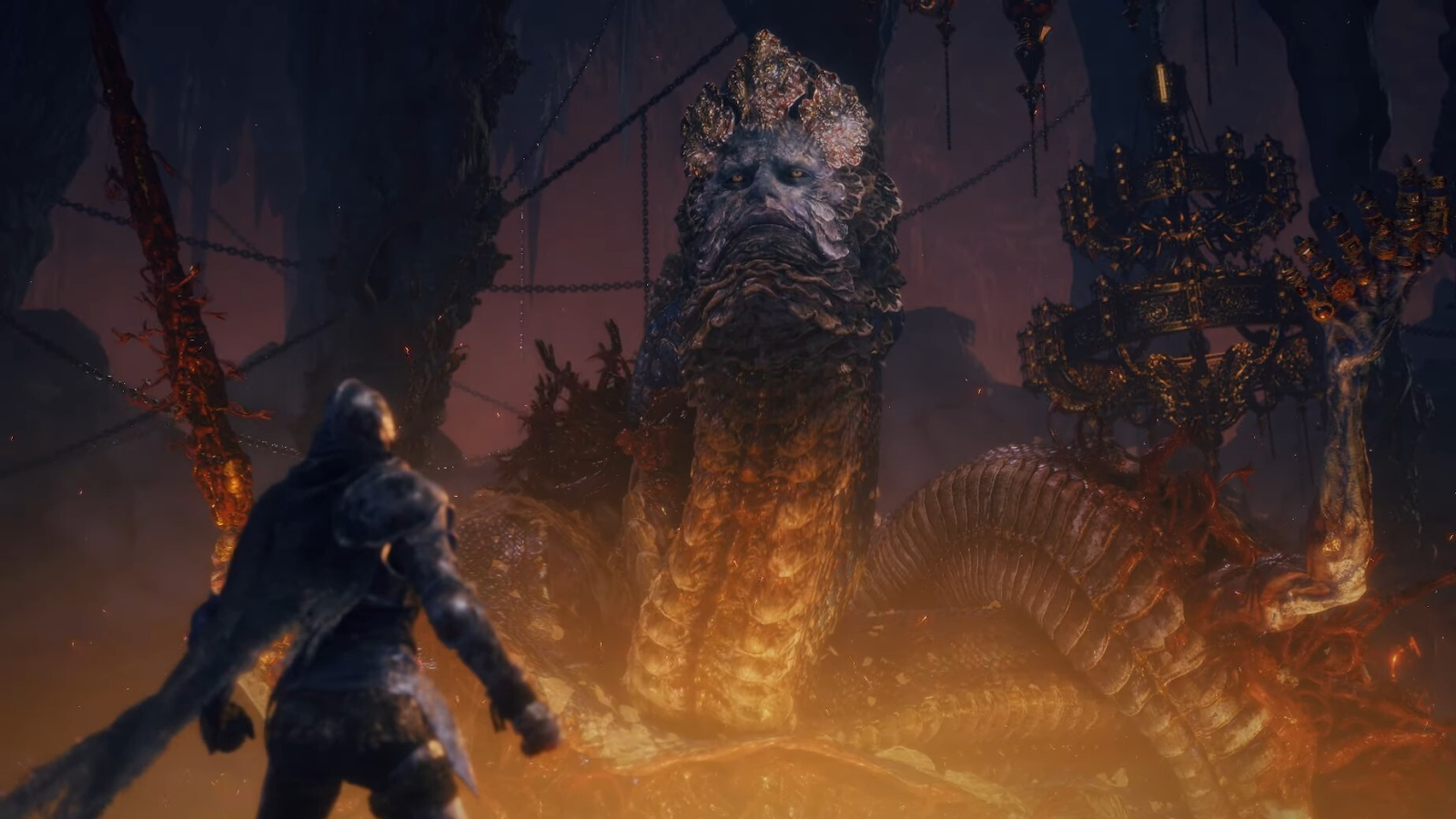
But I suppose I shouldn’t be surprised, given how Sekiro was FromSoft’s attempt at creating a more straightforward narrative with well-defined characters you connected with emotionally. What’s more surprising is that, far from just being a marketing gimmick, you can definitely see George R.R. Martin’s creative fingerprints all over the world-building and the dynamics of a feuding family of pseudo-deities who (save for one, the pale sheep of this ebony flock) all wish to assert their will upon the world regardless of the unmitigated suffering it may cause. Now you might wonder, given this is the man behind A Song of Ice & Fire/Game of Thrones/House of the Dragon, if there is tasteless shock value material like rape and incest involved. To answer that unpleasant question (which I rhetorically asked myself): yes, it most certainly is, and adds in necrophilia – yet, somehow, they make it even weirder than those acts usually are by themselves.
Why?
‘Cause Japan. ‘Cause Nippon. ‘Cause Land of the motherfucking Rising Sun, er, son!
There was a time that the pieces fit
But I watched them fall away
Mildewed and smoldering
Strangled by our coveting
Okay, okay – I’m being facetious. A bit.
In the aforementioned older piece of mine, I argued that part of what made the Western-style high fantasy setting work is due to being filtered through the disparate cultural sensibilities of a Japanese development team. The whole Medievalesque Western Fantasy aesthetic was getting long in the tooth by Dark Souls 3 but – partly thanks to the new setting and GRRM’s contribution to it – the developers managed to make it work at least one more time. But, sooner than later, FromSoft needs to drop such aesthetics and look elsewhere. The world’s a pretty big place with numerous mythologies to borrow from that aren’t from Europe or Scandinavia, actually, and I’d rather see a Mayan/Aztec- or Hindu-themed Soulsborne title than more of this overplayed Tolkien variant shit.
I’ve gone on long enough with this section, so let’s wrap it up with the next…
Bronze Metal Winner
You may’ve noticed how, several paragraphs ago, I mentioned how Bloodborne and Sekiro are my first and second favorite Soulsborne titles which – when accompanied by this section’s title – means Elden Ring is easily my third. The thing is, though, that I’ve put more time into it than Bloodborne and Sekiro combined. Maybe even all of Dark Souls as well. The sum total of my three playthroughs of the game is 868 hours (hey look, a numerical palindrome!). Yet, despite that, I still can’t put it above Bloodborne or Sekiro, and bear with me as I explain why.
As good as the game is as an open-world title, I’d even say the best in years, there’s still…too much of it. Upon hearing there is going to be an upcoming DLC, Shadow of the Erdtree, I couldn’t help but dread the idea of playing it. Within all three of my playthroughs, there was always a point where I just wanted the game to end already. I tried to be a completionist – to fight every boss and collect every item – but I just stopped caring enough to do so and finished as soon as humanly possible. This isn’t something I ever felt with other FromSoft Soulsborne titles, as I was compelled to finish everything before reaching the ultimate climax. A good ludic experience, for me, is one that one cannot separate from it without great difficulty (“Okay, just one more hour…”). To want to stop playing is not a good sign.
But, at the same time, I did spend hundreds of hours playing this game nonetheless but I eventually realized why (get ready for another callback): I’ve had that experience with Skyrim. Multiple times (again, I did tell you to bear with me).
I’ve done the math enough to know
The dangers of our second guessing
Doomed to crumble unless we grow
And strengthen our communication

I’ve never finished the main questline of Skyrim nor am particularly bothered to ever do so. It’s a boring story with boring characters playing out boring events, and everything that is interesting about the game happens outside of it. You can’t help but feel the joy and excitement of discovery as you go in a random direction, purely out of curiosity, to see what happens. Eventually, once you’ve reached every corner of the map – after tens of hours of gameplay – you just give up. There is no more to discover, nothing interesting left to happen, and you move on to something else.
However, weeks or months down the line, you get that urge to play Skyrim again. You’re not entirely sure why, for most of the content eventually bleeds together due to its rote and interchangeable nature, but you must’ve played it that much for some reason…right? I mean, you can recollect those moments punctuated in that blur. Remember how you’re sent skyward for miles, rather perplexingly, after a troll clobbers you overhead? That glitch was fuckin’ hilarious! Then, you’re lured and lulled back in…
The ultimate difference between Elden Ring and Skyrim, when it comes to this phenomenon, is that the former has managed to surpass the latter in making the Sunk Cost Fallacy actually work. Skyrim exposes too much of itself too early, rendering much of the main questline almost entirely optional, and giving you no reason to finish it despite the insistence to do so by the game itself. Whereas Elden Ring, wisely going for the slow-burn approach, knows when to set up enough speedbumps and roadblocks with a deft hand to keep the pacing going and – as to be expected by FromSoft – to entice you enough to explore further and eventually finish the game entirely.
That is most certainly an improvement over Skyrim, especially since the world it creates is a lot more memorable with lore as intriguing as it is cryptic. Yet when I brought it up – many, many paragraphs ago – that each playthrough felt like an entirely different experience, part of me wondered upon my third (and now currently fourth) playthrough if that’s only because so many of this world’s dungeons and boss battles are essentially recycled assets with slight reconfigurations akin to (fittingly) the Chalice Dungeons of Bloodborne. I eventually realized, save for a few occasions, I often forgot which dungeon had which boss and even the level layout. I still stand by what I said about how it adds cohesiveness to the world-building, and the occasionally amusing navigational puzzles, but it’d be dishonest to not see it as a flaw. My memory, much like with Skyrim, filtered it out due to their similarities and makes it feel, like far too many other open-world titles, heavily padded as a result.
Cold silence has a tendency
To atrophy any
Sense of compassion
Between supposed lovers

Ultimately, my point is that there is such a thing as too much of a good thing – and Elden Ring is an example of that. But, importantly, it’s also more of too much of a good thing than Skyrim could ever dream of. There has to be a reason, despite every playthrough leaving me exhausted, I still managed to gravitate towards starting another playthrough. The game is obviously doing something right yet, at the same time, it’s also evidence that the open-world format in videogames is not a sustainable experience. Even the people at FromSoftware, who do level design and world-building better than many others in the industry, still cannot perfect the open-world format. For all our feeble attempts to create this virtual world so immersive that it feels like an entirely different life – our level of tech, as advanced as it is, still can’t be so immersive that we could truly lose ourselves in the game.
I’m not done with Soulsborne titles, as overexposed as they’ve become in recent years, given I do still want to write about Blasphemous and am eagerly awaiting its sequel – among plenty of other entries in the Soulsborne genre (sub-genre?) – but I’m definitely done with open-world games. As much as I’m sure Legend of Zelda: Breath of the Wild or Tears of the Kingdom may be enjoyable as open-world games, especially with their emphasis on delightful art style over high-fidelity graphics, I doubt I can enjoy them fully without – other than owning a Nintendo Switch (which I currently do not) – an indeterminate sabbatical from open-world titles.
Those who seem tired of Soulsborne titles the most, quite understandably, are the developers of FromSoft itself. I can’t blame them and wanting to go back to a franchise that preceded Demon’s Souls – by twelve years – with Armored Core VI: Fires of Rubicon. I mean, who wouldn’t get sick of making iterations of a certain gameplay model for almost a decade and a half? You can only do so much with one thing before exhaustion sets in and, eventually, familiarity will breed contempt.
You need to mix it up, just a little, and – let’s be honest – who doesn’t love giant mechs? All these colossal humanoid tanks pew-pewing each other into oblivion? I mean, you can’t but I’d be either highly skeptical of such a claim or pity you for being a soulless (PUN INTENDED, AGAIN!!!) husk of a human being. How can all those “kablams”, “kablooies”, and “badooms” not cause this sense of primal excitement? I know I certainly feel it! The moment I get my hands on Armored Core VI: Fires of Rubicon, I’ll put everything in my life aside to play it from beginning to end – even if it kills me. All while listening to Pearl Jam’s “Do the Evolution” on an infinite loop, of course…
I’m at peace
I’m the man
Buying stocks
On the day of the crash
On the loose
I’m a truck
All them rolling hills
I’ll flatten ’em out!
Thankfully, the next piece I’ll post – a comparative review of the videogames High On Life and Scorn – won’t appear months from now but next week. I’ve already finished it, actually, around December of last year but wanted to wait until after I wrote about Elden Ring. I could’ve done so before, I’ll admit, but there’s a joke in there that wouldn’t work otherwise if I did. That’s silly, I know, yet I don’t care – it just felt…right.
You’ll see, next time – and thanks for reading!
 NickNameNick